Wirepullers: con la morte di Velupillai Prabhakaran, leader strico delle Tigri Tamil ucciso dall'esercito regolare dello Sri Lanka a maggio 2009, sembrava essersi chiusa definitivamente una pagina di guerra, che affonda le proprie radici nell'epoca del colonialismo britannico. Restava il tempo della riconciliazione, come promesso dal presidente dello Sri Lanka, Mahinda Rajapaksa. Ma la riconciliazione tra singalesi buddisti e induisti tamil, sull'isola che un tempo si chiamava Ceylon, sembra lontana. A renderla difficile una maggioranza, i singalesi, che vive con le paure tipiche delle minoranze e una minoranza, i tamil, che si comporta da maggioranza, forte della vicinanza di 60 milioni di correligionari che vivono appena oltre lo stretto di Perth, nel sud dell'India. In poche parole, una guerra tra religioni. (3)
After 26 years and 70,000 casualties, Sri Lanka’s civil war has ended—for now. The key to easing the fears of the country’s historically beleaguered Buddhist majority while protecting its Hindu minority? Rediscovering the blend of faiths that laid the foundation for the ancient kingdom of Kandy.
I had always wanted to go to Kandy, for no other reason than that I was in love with the name: so airy, fanciful, and obviously suggestive of sweet things. I first found Kandy on a map of what was then called Ceylon, decades ago as a young man. Little did I know that it would one day have urgent revelations for me, more dark and poignant than sweet.
My journey began at Colombo’s crumbling train station, with its white facade like a cake about to melt. The first-class ticket cost a little more than $3 for the three-hour journey from Sri Lanka’s steamy Indian Ocean capital, through deep forest, to an altitude of 1,650 feet. The rusted railway car rattled and groaned its way uphill. Soon banana leaves were slapping against the train as we entered a relentless tangle of greenery.
The forest thickened with the crazy chaos of dark hardwood foliage. Vines choked every tree. The torrential rain of the southwest monsoon invigorated the pageant, shrieking and beating against the leaves as sheets of mist moved across the jungle. Then came swollen brown rivers, with water buffalo half sunk in mud near the pottery-red banks. Here and there the forest would break to reveal a shiny, rectilinear carpet of paddy fields, only to close in again, denser than before. I saw scrap-iron hutments and tiled rooftops the color of autumn leaves, and smoky blue hillsides creased by waterfalls and half-eaten by gray monsoon clouds. Other breaks in the forest revealed the occasional bell-shaped Buddhist dagoba, or stupa, with its soaring-to-heaven whiteness against the otherwise fungal-green tableau. As we drew near to Kandy, we passed through several narrow tunnels. In the pitch black, the creak of the train reverberated against the rock walls.
Kandy in early evening was a study in rust and mildew, with a crawling-uphill line of food stalls and other storefronts, so tattered and musty they seemed about to disintegrate. Yet that was only a first impression. Later ones would reveal how I had misjudged the scene. The storefronts—eateries, jewelers, mini-supermarkets, five-and-dime shops—were merely in need of new windows and paint jobs; they were in fact doing a brisk business. The streets were clean, the overhead fans worked in every shop I entered, and few beggars were visible. The middle class was evidently thriving, as demonstrated by the number of lavish, assembly-line weddings at my hotel during these auspicious days at the beginning of the monsoon.
A motorized rickshaw brought me to the Hotel Suisse, a seedy, dark-wooded British-colonial pile built in the mid-19th century. It had a well-stocked bar with boxy sofas and a billiard room, and was half empty: a cliché, in other words. My room cost $50. It lay off a portico overlooking a garden and Kandy Lake, which at dusk was tinted a mystical gray and dotted with lizards that crawled out onto the rocks. A thing of rare beauty, the lake was created by the last king of Kandy, Sri Wickrama Rajasinha, at great cost. After a stretch in Colombo’s punishing heat, I sat on the portico, yes, with a gin-and-tonic, and enjoyed the energizing coolness of a higher altitude, watching and listening to the rain on the lake.
Kandy defines quaintness, to such an extent that you begin to see the town in the black-and-white of a photo negative. But Kandy is also gaudy and magical. Within this forest town are Sri Lanka’s principal Buddhist shrines, swimming in gold and Technicolor. Across the lake from the Hotel Suisse is the Temple of the Sacred Tooth Relic, or Sri Dalada Maligawa, a shrine complex that was built in the 17th and 18th centuries by Kandy’s Sinhalese Buddhist kings and holds a tooth of the Buddha—Prince Siddhartha Gautama—said to have been taken from his funeral pyre in 543 B.C.
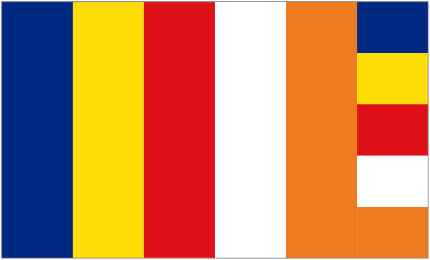
The Temple of the Tooth is a site of mass pilgrimage, where the tourist instinctively knows to dress modestly, remove shoes, stay quiet, and lurk in the background. Within the mottled stone walls of the complex is an immense layout of gardens lined with striped Buddhist flags: the blue stripe signifying loving-kindness, the yellow the middle path away from extremes, red the blessings of practice, orange the Buddha’s teachings, and white the purity of the dharma, or universal truth, leading to liberation. Hundreds of Sinhalese sit in a two-story room in meditative positions, softly chanting and offering up mountains of pink lotuses, purple waterlilies, and white
 jasmines in front of the gilded casket that holds the tooth. Babies are everywhere, remarkably silent, held tightly against the chests of women in long cotton wraparounds. Leaf monkeys watch the whole scene from the massive, fanlike roofs.
 From this and the other temples and monasteries around Kandy radiates the overwhelming and studied richness of the two chief colors of Buddhism: a rich, maroon-like red and a dazzling gold, painted on stone statues and sumptuously draping the giant sitting Buddha in each temple. The murals in these temples are faded and blackened with age. Only in the Eastern Orthodox churches in the Balkans have I come across a clutter of magnificence to match what I have seen in the Buddhist sanctuaries of Sri Lanka. Even as you experience this whole sensual feast, your bare feet press against cold and wet stone, since the rains are constant during the southwest monsoon.
Here, you are alone with your thoughts. Sri Lanka is in general a less panicky, less frantic, less intrusive version of India. Only rarely are you hassled. And Kandy, up in the hills, away from the crowded coastal highway, is a concentrated version of the country’s charms.
Alas, when you fall in love with a place, you encounter its history, which is often tragic. In fact, Kandy has remained seedily quaint, its monuments and ambience unravaged by mass tourism, only because Sri Lanka has experienced more than a quarter century of civil war between ethnic Sinhalese Buddhists and Hindu Tamils. And the origins and conduct of that savage conflict have drawn, in many ways, from the same emotional wellsprings as the tradition of worship at Kandy’s tranquil Buddhist shrines.
Buddhism holds an exalted place in the half-informed Western mind. Whereas Christianity,
 Islam, Judaism, and Hinduism are each associated, in addition to their thought, with a rich material culture and a defended territory, Buddhism, despite its great monuments and architectural tradition throughout the Far East, is somehow considered purer, more abstract, and almost dematerialized: the most peaceful, austere, and uncorrupted of faiths, even as it appeals to the deeply aesthetic among us. Hollywood stars seeking to find themselves—famously Richard Gere—become Buddhists, not, say, orthodox Jews.
 Yet Buddhism, as Kandy demonstrates, is deeply materialistic and demands worship of solid objects, in a secure and sacred landscape that has required the protection of a military. There have been Buddhist military kingdoms—notably Kandy’s—just as there have been Christian and Islamic kingdoms of the sword. Buddhism can be, under the right circumstances, a blood-and-soil faith.
Kandy may be the Buddhist world’s best example of this. From the late 16th to the early 19th centuries, the kingdom of Kandy sturdily held out against European invaders: the Portuguese, the Dutch, and the British in their turn. “Like many other armies in peasant and tribal societies,” writes Channa Wickremesekera in Kandy at War: Indigenous Military Resistance to European Expansion in Sri Lanka 1594 to 1818 (2004), “the Kandyan army fought in loosely organized and highly mobile units depending on a flimsy logistical base,” making optimum use of its rugged, jungly terrain. It was very much like a 21st-century guerrilla insurgency, in other words—inspired, in this case, by the need to defend faith and homeland against heathen Europeans. The dense forest through which I had passed on my train ride constituted the graveyard of European attempts to reach Kandy, with many a Portuguese, Hollander, and Briton dying or giving up, exhausted and demoralized, afflicted by disease amid the cruel jungle so well described by Leonard Woolf in his 1913 novel, The Village in the Jungle:
For the rule of the jungle is first fear, and then hunger and thirst. There is fear everywhere: in the silence and in the shrill calls and the wild cries, in the stir of the leaves and the grating of branches, in the gloom, in the startled, slinking, peering beasts.
Eventually, the improved muskets and light artillery developed in Europe proved too much for the Kandyans. The British, explains Wickremesekera, unlike the Portuguese and Dutch, had the added advantages of “mastery over the neighboring Indian subcontinent and an army of over 100,000 soldiers when they clashed with Kandy.” They toppled King Wickrama of Kandy in 1815. He may have dug the lake, but he had been a tyrant and torturer. At least that was how the British rationalized their actions.
Thus the redoubtable kingdom of Kandy, for centuries such a rebuke to European attempts at conquest in Asia, became a trope in the warrior imagination of the Buddhist Sinhalese. To be sure, the quest to recover Kandy’s lost honor and glory played a role in the bloody and morally unclean victory that the Buddhist Sinhalese won over an ethnic Tamil insurgency in May, after 26 years of fighting. More broadly, the history of Kandy—a cultural and artistic repository of 2,300 years of Buddhist worship that the Europeans rarely left in peace—has imbued Sinhalese with the sense of being repeatedly under siege.
Regional demography hasn’t helped. Indeed, the majority-Buddhist Sinhalese, who constitute three-quarters of Sri Lanka’s population of 20 million, have lived in fear of being overwhelmed by the Hindu Tamils, who, although they are only 18 percent of the population, can theoretically call upon their 60 million ethnic and religious compatriots living just across the Palk Strait in southeastern India. The history of Tamil invasions against the only homeland that the Buddhist Sinhalese possess is not just the stuff of ancient history, but a living reality underpinned by latter-day Tamil terrorism. Writes the Sri Lankan scholar K. M. de Silva:
 Sri Lanka’s location off the coast of South India, and especially its close proximity to [the Indian state of] Tamilnadu, separated by a shallow and narrow stretch of sea serves to accentuate this sense of a minority status among the Sinhalese. Their own sense of ethnic distinctiveness is identified through religion—Theravada Buddhism—and language—Sinhala. They take pride in the fact that Buddhism thrives in Sri Lanka while it has practically disappeared in its original home, India. Their language, Sinhala, has its roots in classical Indian languages, but it is now a distinctly Sri Lankan language, and one that is not spoken anywhere else.
 The Sinhalese, argues de Silva, see their historical destiny in preserving Theravada Buddhism from a Hindu revivalist assault, with southern India the source of these invasions. As they see it, they are a lonely people, with few ethnic compatriots anywhere, who have been pushed to their final sanctuary, the southern two-thirds of Sri Lanka, by the demographic immensity of majority-Hindu India. The history of the repeated European attacks on their sacred city, Kandy, the last independent bastion of the Sinhalese in that southern two-thirds of the island, has only accentuated the sense of loneliness.
The Sinhalese must, therefore, fight for every kilometer of their ethnic homeland, Bradman Weerakoon, an adviser to former Sri Lankan presidents and prime ministers, told me. As a result, like the Serbs in the former Yugoslavia, the Jews in Israel, and the Shiites in Iran, the Sinhalese are a demographic majority with a dangerous minority complex of persecution.
The Hindu Tamils, for their part, have been labeled a minority with a majority complex, owing to the triumph of Hinduism over Buddhism in southern India in the fifth and sixth centuries A.D., and the subsequent invasions from India’s south against the rich and thriving Buddhist city-state of Anuradhapura in north-central Sri Lanka. These invasions resulted in the creation, by the 14th century, of a Tamil kingdom that, in turn, helped lay the groundwork for Tamil majorities in the north and east of the island.
Sri Lanka’s post-independence experience, including its civil war between Sinhalese and Tamils, has borne out the worst fears of both communities. The Sinhalese have had to deal with a guerrilla insurgency every bit as vicious and suicidal as the better-known ones in Iraq and Afghanistan. The Tamils, for their part, have had to deal with coercion, discrimination, and the utter failure of Sinhalese government institutions to protect their communal rights. There is nothing crueler than a majority that feels itself a minority.
In 1976, a certain Velupillai Prabhakaran founded the Tamil New Tigers, who would later become known to journalists around the world as the Liberation Tigers of Tamil Eelam, or LTTE: “Tamil Tigers” for short. Prabhakaran would develop into one of the world’s most hunted terrorists, as well as one of its most feared and capable guerrilla leaders. The young Prabhakaran had killed animals with a slingshot and air gun, and practiced building homemade bombs. He stuck pins under his nails to build up his tolerance for pain, and killed insects with needles to prepare himself to torture the enemy.
Prabhakaran turned the Tamil Tigers into a quasi-cult terrorist group that venerated him as a demigod. To comprehend the Tamil Tigers, wrote the late American scholar Michael Radu, “imagine Jim Jones’ Temple cult of Guyana in possession of a ‘navy’ and ‘air force,’ as well as (at its height) some 20,000 fanatical and armed zombie followers.” Indeed, Prabhakaran’s Tamil Tigers constituted the world’s first guerrilla insurgency with its own air force (Czech-made Zlin Z143s) and navy (explosive-packed fishing trawlers and a small submarine force). He imposed a blood tax on the population under his control in the north and east, requiring each family to provide a son to the Tigers. One wing of the organization—the Black Tigers—was dedicated to murder and assassination. Until the early 1990s, the Tigers held a record for suicide bombings, a tactic that they had largely pioneered. The Tigers used many tens of thousands of civilians as human shields and children as porters during combat. The very history of the Hindu Tamil Tigers shows that perverse violence, the embedding of warriors amid large numbers of civilians, and the rampant use of suicide bombing are not crimes specific to Muslims.
To defeat such a group, the Buddhist Sinhalese relied on a powerful sense of communal religious
 identity. This identity has been embodied, in particular, by the current Sri Lankan government of Mahinda Rajapaksa and two of his brothers: the defense secretary, Gotabhaya Rajapaksa; and the president’s most trusted adviser, Basil Rajapaksa. Together, the three brothers have marked a decisive break from previous Sri Lankan governments. Whereas the governments of the Senanayake and Bandaranaike family dynasties hailed from the relatively moderate Colombo-centric elite, the Rajapaksas are more representative of the somewhat xenophobic, semi-literate, and collectivist rural part of the Sinhalese Buddhist population. The Rajapaksas, with the full backing of the Buddhist clergy, have reconstituted something out of the Sinhalese past: an ethnically rooted dynasty, like the Buddhist kingdoms of Kandy of old, dedicated to ethno-national survival, unaccountable to the cabinet and parliament.
 Mahinda Rajapaksa was elected in 2005 to win the war outright, and he succeeded in the most brutal fashion: by abducting or killing journalists and lawyers to silence the media, even as he conducted a counterinsurgency campaign that had no moral qualms about the deaths of the thousands of Tamil civilians that the Tamil Tigers were using as human shields. Of the 70,000 people killed in the war since 1983, 10 percent, mainly civilians, were killed in the last few months of fighting in 2009.
I was in Sri Lanka on May 18, 2009, the day the war was declared over, and the body of Prabhakaran, killed in last-ditch fighting, was displayed on television, as government forces mopped up the final few hundred yards of Tamil Tiger territory. The next morning, May 19, I drove through the southern coastal heartland of the Buddhist Sinhalese. Everywhere there were parades and flag-bedecked, horn-honking rickshaw convoys, with young men, many of them unemployed, shouting and setting off masses of firecrackers. An effigy of Prabhakaran’s body was dragged and burned. I sensed a scary and wanton boredom in these young men, as if the same crowds, under different circumstances, could be setting fire to Tamil homes, as had been done in earlier decades. I noticed that the closer I got to the ethnically mixed population center of Colombo, the fewer such demonstrations I saw.
President Rajapaksa came to Kandy a few days later, on May 23, to receive the blessings of the chief Buddhist monks at the Temple of the Tooth for winning the war. He expressed no apologies or remorse for the victims of the war, and he promised the monks, “Our motherland will never be divided [again].” He told them that there were only two types of Sri Lankans, those who love the motherland and those who don’t. Because he conceives of the motherland as primarily Buddhist, his words carried too little magnanimity.
The monks had acquiesced in this descent into communal intolerance. They have long enjoyed the uses of political power and hark back to a past when they were the rousing nationalist force behind Ceylonese kings. Now they could close a long historical chapter that began at the Temple of the Tooth in March 1815, when the Kandyan Convention was signed, ceding all of Ceylon to the British after the defeat of the last Kandyan king, Wickrama. British rule in Ceylon, lasting until independence in 1948, was followed by decades of communal unrest culminating in the civil war. At last, these monks could look forward to a Buddhist-run state that would have full sovereignty over the island.
 But even if the artistic grandeur of Kandy has helped form the emotional source of Buddhist nationalism, which has proved itself as bloody as other religious nationalisms, Kandy’s religious monuments also offer a much deeper lesson: the affinity—rather than the hostility—between Buddhism and Hinduism. Buddhism arrived in Sri Lanka from India as part of the missionary activity of the great Mauryan emperor Ashoka in the third century B.C. And later eras of Indian history would witness an amalgamation of Buddhist teachings into Hinduism. A few miles from Kandy, deep in the forest amid glistening fields of tea, I saw statues of the Buddha and of Hindu gods under the same roofs, together in their dusky magnificence: in dark stone vestibules at the 14th-century temples of Gadaladeniya, Lankatilake, and Embekke. At the temple of Embekke, I lifted aside a veiling Hindu tapestry to behold the Buddha. At Lankatilake, I saw the Buddha surrounded on all four sides by devales (shrines) devoted to the deities Upulvan, Saman, Vibhisana, and Skanda—of mixed Hindu, Buddhist, and Persian origin. At the Buddhist shrine of Gadaladeniya, I saw stone carvings based on the style of the Hindu empire of Vijayanagar in Andhra Pradesh, in southern India. Each of these temples “reflects the fusion of Buddhism and Hinduism,” writes SinhaRaja Tammita-Delgoda in Eloquence in Stone: The Lithic Saga of Sri Lanka (2008).
 In fact, Wickrama, the Buddhist king who was deposed by the British, became the last in a dynasty, the Nayakkars, that was South Indian and Hindu in origin; even as its members patronized Theravada Buddhism, they sought Hindu brides for their male Buddhist heirs. The British, by ending this dynasty and thus breaking the link between Buddhism and Hinduism, helped set the stage for the polarization of politics in the postcolonial era. The truth was that Theravada Buddhism, so concentrated on ethics and the release from worldly existence, was too austere for the Kandyan peasantry, who were drawn to the color and magic of the Hindu pantheon. Kandy and its forests are a monument not only to Buddhism, but to Hinduism as well. The historical and aesthetic legacy of Sri Lanka that long predates modern statehood is, in the final analysis, deeply syncretic. Only when Sri Lanka’s political leadership recognizes that legacy will communal peace be at hand—and with it the arrival of globalization and chain hotels, and the end of Kandy’s quaintness.
Autore: Robert D. Kaplan
Fonte: www.theatlantic.com


.jpg)


 Post
Post