Cerca nel blog

Visualizzazione post con etichetta Scienza. Mostra tutti i post

mercoledì 12 agosto 2009

Turin Shroud confirmed as a fake


by Richard Ingham

PARIS, June 21 (AFP) - A French magazine said on Tuesday it had carried out experiments that proved the Shroud of Turin, believed by some Christians to be their religion's holiest relic, was a fake.

"A mediaeval technique helped us to make a Shroud," Science & Vie (Science and Life) said in its July issue. The Shroud is claimed by its defenders to be the cloth in which the body of
Jesus Christ was wrapped after his crucifixion.

It bears the faint image of a blood-covered man with holes in his hand and wounds in his body and head, the apparent result of being crucified, stabbed by a Roman spear and forced to wear a crown of thorns.

In 1988, scientists carried out carbon-14 dating of the delicate linen cloth and concluded that the material was made some time between 1260 and 1390. Their study prompted the then archbishop of Turin, where the Shroud is stored, to admit that the garment was a hoax. But the debate sharply revived in January this year.

Drawing on a method previously used by skeptics to attack authenticity claims about the Shroud, Science & Vie got an artist to do a bas-relief -- a sculpture that stands out from the surrounding background -- of a Christ-like face.

A scientist then laid out a damp linen sheet over the bas-relief and let it dry, so that the thin cloth was moulded onto the face. Using cotton wool, he then carefully dabbed ferric oxide, mixed with gelatine, onto the cloth to make blood-like marks. When the cloth was turned inside-out, the reversed marks resulted in the famous image of the crucified Christ.

Gelatine, an animal by-product rich in collagen, was frequently used by Middle Age painters as a fixative to bind pigments to canvas or wood.

The imprinted image turned out to be wash-resistant, impervious to temperatures of 250 C (482 F) and was undamaged by exposure to a range of harsh chemicals, including bisulphite which, without the help of the gelatine, would normally have degraded ferric oxide to the compound ferrous oxide.

The experiments, said Science & Vie, answer several claims made by the pro-Shroud camp, which says the marks could not have been painted onto the cloth.

For one thing, the Shroud's defenders argue, photographic negatives and scanners show that the image could only have derived from a three-dimensional object, given the width of the face, the prominent cheekbones and nose.

In addition, they say, there are no signs of any brushmarks. And, they argue, no pigments could have endured centuries of exposure to heat, light and smoke.

For Jacques di Costanzo, of Marseille University Hospital, southern France, who carried out the experiments, the mediaeval forger must have also used a bas-relief, a sculpture or cadaver to get the 3-D imprint.

The faker used a cloth rather than a brush to make the marks, and used gelatine to keep the rusty blood-like images permanently fixed and bright for selling in the booming market for religious relics.

To test his hypothesis, di Costanzo used ferric oxide, but no gelatine, to make other imprints, but the marks all disappeared when the cloth was washed or exposed to the test chemicals.

He also daubed the bas-relief with an ammoniac compound designed to represent human sweat and also with cream of aloe, a plant that was used as an embalming aid by Jews at the time of Christ.

He then placed the cloth over it for 36 hours -- the approximate time that Christ was buried before rising again -- but this time, there was not a single mark on it.

"It's obviously easier to make a fake shroud than a real one," Science & Vie report drily.

The first documented evidence of the Shroud dates back to 1357, when it surfaced at a church at Lirey, near the eastern French town of Troyes. In 1390, Pope Clement VII declared that it was not the true shroud but could be used as a representation of it, provided the faithful be told that it was not genuine.

In January this year, a US chemist, Raymond Rogers, said the radiocarbon samples for the 1988 study were taken from a piece that had been sewn into the fabric by nuns who repaired the Shroud after it was damaged in a church blaze in 1532.

Rogers said that his analysis of other samples, based on levels of a chemical called vanillin that results from the decomposition of flax and other plants, showed the Shroud could be "between 1,300 and 3,000 years old."

From: http://www.physorg.com/news4652.html

Ipazia di Alessandria


lunedì 10 agosto 2009

The Blood of St. Januarius

Of L.Garlaschelli, F.Ramaccini, L.Della Sala

Introduction


A sealed glass vial containing a dark unknown substance, allegedly the clotted blood of San Gennaro (St Januarius), is shown several times a year to a packed crowd in the Cathedral of Napoli (Naples). Whilst the container is being handled during a solemn ceremony, the solid mass suddenly liquefies before everybody's eyes. [1] [2]
This well-documented phenomenon is still regarded as unexplained [3] by believers and sceptics alike. Noted parapsychologist Hans Bender defined it the paranormal phenomenon with the best and historical documentation; [4] physicist Enrico Fermi seems to have expressed interest as well.

It is also one of the few recurrent non-medical, physical "miracles" that might be studied scientifically.

St Januarius


Tradition has it that St Januarius was bishop of Benevento (a town near Naples) later to die a Christian martyr beheaded at the hands of the Emperor Diocletianus, in 305 AD at Pozzuoli.

Ceremonies in his honour were instituted by archbishop Orsini of Naples in 1337 [1] No mention of the liquefying blood was made however, until 1389, when on August 17, the phenomenon was first reported. A chronicle of Naples written in 1382[5] describes the Januarian cult but still makes no mention of either the miracle or the relic. It is very likely that "the blood of Januarius" is one of the many relics to materialize during the Middle Ages[6]

Today the rite is on one hand still encouraged (is performed by the archbishop in the Naples cathedral); on the other hand it was never officially declared a miracle by the Catholic Church, which leaves scientists free to express their opinions.[7]

The relic and the Ceremony


The relic is an ancient, round and flattened, sealed glass vial, of an estimated volume of 60 ml, half-filled with the dark unknown substance. The vial, together with an empty smaller one, is encased between the two rounded glass walls of the portable silver reliquary.

During the ceremony the reliquary is repeatedly picked up, moved around and upturned to check whether the liquefaction has taken place. If it has, the dark mass is seen to flow freely into the vial. The liquefaction sometimes takes place almost immediately, or can take hours, even days.

It is claimed that other phenomena take place inside the reliquary. The liquid mass is said to boil or froth, the colour to change from a dark to a reddish brown, and the volume and even the weight to increase.[8] Part of the mass (the globo) is sometimes seen to remain solid and float in the liquid.

Toward a rational approach


When blood is drawn from a living body and poured into a container, the soluble serum protein fibrinogen forms a network of insoluble fibrin, which in turn binds the erythrocytes resulting in a jelly-like clot. This clot can be mechanically broken down, but once this has been done, clotting cannot reoccur. Thus, the resolidification of a blood sample would be even more surprising than its first liquefaction. The re-clotting process of the relic of Naples generally occurs when the vials are safely within their locked vault.

A number of explanations, other than the intervention of a supernatural power, have been put forward over the years. Scores of totally unproven influences has been called into play: "magnetic" forces from Vesuvius (the nearby volcano), psychokinesis from the crowd, poltergeist and spiritualistic type effects, to name but a few.

Some other hypotheses were just provocations or pseudoscience. [1]

  • The miracle is a magic trick, a hoax consciously performed by the Church (this would leave to explain how the trick is done, and how its secret could be kept for six centuries).
  • The contents of the vial are a photo-sensitive substance changing its state from solid to liquid under the influence of light (no example of such material was ever proposed).
  • The unknown substance is a periodical growth of microorganisms:(same as above, and not possible within a sealed container).
  • The substance is a hygroscopic deliquescent solid, becoming liquid when it absorbs moisture from the air (this hypothesis would also account for the alleged weight variation, but would require an open vial. Furthermore, temperature raises needed to return the hydrated material to the anhydrous state would probably be completely outside the range of those the relic is ever exposed to).
A few actual simulation were also tried:

In 1890, Albini used mixtures of powdered chocolate and sugar in water, or casein and salt in milk serum. [9] These murky suspensions of solids in dense liquid separate to form a thick crust at the surface, which acts like a plug, solid enough to stop the heavier, liquid part below from flowing freely within the container, making it appear solid. When shaken, the two components mix, thus simulating a change of state. Albeit interesting, this attempt was rather crude and failed to impress observers observers familiar with the relic.

A sounder suggestion was that the unknown substance is simply a mixture with a low-melting point. Solid when stored in a somewhat cooler place, it would melt when taken to the warmer altar, near burning candles, amidst a fervent crowd. This hypothesis was first recorded as early as 1826 [10] and was quickly supported by numerous recipes, mostly based upon waxes, fats or gelatines (plus suitable dyes).[11] A practical, not anachronistic one, was recently suggested by Nickell and Fisher.[12] However, mixtures such as these, have a constant melting point, whereas the blood-liquefaction ceremony can be performed at different room temperatures (May, September, December). This and the problem of inducing the change in temperature to produce the "miracle" (candles, for instance, are no longer brought near the relic) remain the basic limitations of this hypothesis.

The thixotropic hypothesis


Thixotropy might prove a good hypothesis to explain this "miracle".[13] [14] [15] Thixotropy denotes the property of certain gels to became more fluid, even from solid to liquid, when stirred, vibrated, or otherwise mechanically disturbed, and to resolidify when left to stand. Common examples of such substances are catsup, mayonnaise and some types of paints and toothpastes.

Thus, the very act of handling the reliquary, repeatedly turning it upside down to check its state, might provide the necessary mechanical stress to induce the liquefaction. A successful performance of the rite, therefore, does not need conscious cheating, while not excluding its occurrence, as gentle or sharp movements can certainly control the timing of the liquefaction.

Indeed, over the centuries, unexpected liquefactions have often been observed whilst handling the relic case for repairs [1]

In support of the thixotropic hypothesis, we made up samples whose properties resembled those of the relic. We used substances that would have also been available in the fourteenth century. After some testing with bentonite clays (producing a thixotropic but unpleasantly mud-like gel), [16] we settled for a reddish-brown FeO(OH) colloidal solution[17] (see box ).

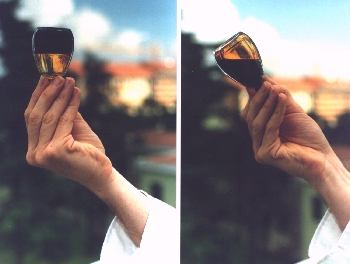
This gel is the right shade of brown without the addition of any dye; it becomes perfectly liquid when shaken See Fig. 1 ) and, just like the relic, can even produce the globo and bubbles on its shiny surface (The real boiling even of a volatile liquid in a closed vessel under such conditions is quite untenable).
THIXOTROPIC IRON HYDROXIDE GEL IN THE SOLID (LEFT) AND LIQUID STATE (RIGHT).


All the compounds for this concoction could have been readily available to a Neapolitan artist or alchemist of the 1300. CaCO3 (from chalk, i.e. limestone, or crushed eggshells) also formed the basis of many white pictorial pigments. K2CO3, available from wood ashes was also well-known, and can be used instead of CaCO3.

The only source of FeCl3 at that time was a mineral called molysite, which occurs naturally only near active volcanoes. Notably, Naples is near Mount Vesuvius. Moreover, after the blood of Januarius miraculously liquefied in 1389, a number of similar miracles occurred in and around Naples, even if most of them seem to have failed after some time. These coincidences might simply have been imitations or else have come as the results of the presence of molysite in that particular area.

The only questionable step might be the dialysis, given that the earliest record (brine passing through a bladder) dates back to the early 1600s.[18] It might be recalled however, that in the Middle Ages dyes were stored in gut bags or bladders (maybe sometimes even under water, to retard oxidation). This practice went on until the introduction of metal tubes, around 1840. These materials (as well as parchment) were used as typical dialysis membranes prior to the age of polymers. Furthermore, a common practice was to precipitate lakes by adding alum or basic compounds to dyes, and filtering them through a felt tube (Hippocrates' sleeve). These practices are just a step away from ours; a medieval artist experimenting with pigments might well have stumbled across it.

In 1389, the Cathedral of Naples was in construction and artists from all over Italy were present. At that time the king was Robert of Anjou, a pious person, who would certainly have been pleased by a "holy blood relic".

In those days the need for relics was widespread as were the attempts to counterfeit them. The shroud of Turin has been carbon-dated back to those same years.

Thixotropy was first tentatively reported in 1863 and named in 1927. As far as we now know, the earliest mention of thixotropy in connection with Januarius is a personal communication from E. Newton Harvey to Henry Green and Ruth N. Weltmann, contributors to a 1946 book, who reported it in a footnote. [19] This interesting quotation, wholly overlooked by all skeptic or believer literature dealing with the miracle [20] [11] was reappraised about a year after our communication by fellow skeptical chemists.

Tests and analyses


Strangely, the possibility of investigating a recurrent unexplained phenomenon, has instigated very little scientific experimentation.

Since the Catholic Church has always forbidden the opening of the sealed containers, a spectroscopic analysis was first performed in 1902 [21] . The instrument was a prism spectroscope, the light source was a candle with grains of salt on the wick providing the sodium D lines. The light was shone through a thin layer of the fluid "blood" and four layers of glass (the two walls of the ampoule plus the two of the relic case). It was reported that the characteristic absorption bands of hemoglobin were detected.

The same analysis was replicated in 1989 [20] using the same type of prism spectroscope. This time the light source and the D lines were provided by electric lamps, and the spectra were recorded photographically. Again, the detection of hemoglobin was reported. This test is always referred to as the "scientific proof" of the presence of blood in the vial. However, the following facts should be considered:

a) The results were not submitted to a refereed Journal, but printed privately by the Neapolitan Curia. The booklet is on sale at the Cathedral bookstall.

b) It is not clear why an old-fashioned prism spectroscope was used instead of a more reliable modern electronic spectrophotometer.

c) No colourless compounds and/or suspension of opaque solids will show up in a visible spectrum.

d) The Authors themselves acknowledge that other red dyes could be mistaken for hemoglobin.

e) Measurements were made on similar old glass to rule out deformations or anomalous absorption bands. The correct method would have been to make measurements at two different liquid thicknesses and determine the spectrum of the reliquary contents by difference (old glass is known to sometimes contain impurities in the region of interest).

f) During the test, hematin and hemochromogen bands were said to appear (after 3 and 9 min) and overlap the hemoglobin bands, as if recording a "miracle in progress". It is worth pointing out that, in any case, at the time of testing the mass had already been liquefied for hours.

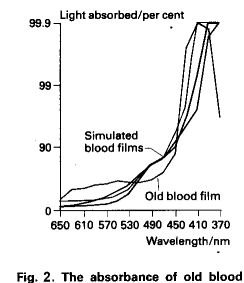
g) If visual measurements (having a limit at ca 400 nm) are adopted , the diagnostic maximum of the Soret band of blood at 410 nm cannot be detected; recent investigations [22] have demonstrated that under these conditions our FeO(OH) gel has spectra that are very similar to those of old blood, since in the latter the characteristic bands of oxyhemoglobin at 545 and 575 nm are lacking owing to the decomposition of oxyhemoglobin into methemoglobin and other derivatives. (See Fig. 2)
ABSORBANCE OF OLD BLOOD (SOLID LINE) AND SIMULATED BLOOD (DASHED LINES) FILMS.


h) The spectra show no wavelength calibration, and appear to be of extremely poor quality, exhibiting some unusual abnormalities, such as very sharp colour contrast and distorted spectral distribution. As a matter of fact, no clear absorption band can even be identified in the printed reproduction.

In summary, we surmise that the 'scientific' claim that the reliquary contains blood is based on very flimsy grounds.

Volume variations of the "blood" are simply anecdotal claims: no records (e.g. of the relic hold level against a scale) are available for this claim. They could be due to the viscous mass sticking to the walls, or to unsymmetries in the vial shape.

Colour variation are undocumented as well. In any case, a dark mass does show different colour hues when seen by transparency (i.e. as a liquid film on the glass) or when by reflection (i.e. as still a solid); this is also visible in our own FeO(OH) gel.

Erratic weight variations were recorded in 1900 and 1904 (with an increase of up to 28 g on an estimated amount of "blood" of 30 ml,[23] but 3% of the total weight of the relic case. [12] Again, these data were published only in a religious magazine (no experimental conditions or balance model reported). Moreover, even a booklet published by Church Authorities and available at the Duomo bookstall,[24] reads " Tests performed during the last five years by using electric balances failed to confirm any weight variation".

Conclusion


Further tests to investigate the real nature of the holy "blood" without opening the ampoule come readily to mind: for example, molecular absorptions and fluorescence spectroscopy, and Raman scattering measurements, made with modern electronic instruments by qualified spectroscopists. Controlled temperature increments and shock tests also represent non-destructive analytical methods by which our or alternative hypotheses might be verified or disproved. Whether these simple tests will be allowed to go ahead wholly depends upon the Catholic Church. At present however, given that the phenomenon has been replicated, it would be rather too naive to consider it irreproducible or unexplainable.

Acknowledgements. We thank Prof. Steno Ferluga for encouragement at the early stage of this project and Ms Gillian Jarvis for her help with the English version of the paper.

References


1) G. B. Alfano and A. Amitrano, Il miracolo di S. Gennaro: documentazione storica e scientifica. Napoli: Scarpati, 1924
2) M. L. Straniero, Indagine su San Gennaro. Milano: Bompiani, 199
3) Encyclopaedia Britannica 15th Edn, vol 6, p 495. 1985
4) H. Bender, Verbogene Wirklichkeit, Olten: Walter-Verlag AG, 1973
5) A. Altamura ed., Cronaca di Partenope (1382). Napoli, 1974
6) J. Bentley, Restless Bones: The story of Relics. London: Constable, 1985
7) M. Giordano, p 10 in Atti del convegno nel VI centenario della prima notizia della liquefazione del sangue(1389-1989) Napoli, 16 dic. 1989, Torre del Greco (Napoli), 1990
8) P. R. Smith, Chem. Br., 1993, 29, 116
9) G. Albini, Rendiconto della Reale Accademia delle scienze fisiche e matematiche (Napoli), 1890, Feb., 24
10) E. Salverte, Des sciences occultes ou essai sur la magie, les prodiges et les miracles. Paris: Baillière, 1826
11) H. Broch, Le Paranormal, p 109. Paris: Seuil, 1989
12) J. Nickell and J. Fisher, Mysterious Realms, p 159. Buffalo, N.Y.: Prometheus Books, 199
13) L. Garlaschelli, F. Ramaccini and S. Della Sala, Nature, 1991, 353, 507
14) R. Meadows, Chem Matters, 1993, 11, 12
15) L. Garlaschelli, F. Ramaccini and S. Della Sala, Skeptical Enquirer, 1993, 17, 209
16) S. Della Sala and F. Ramaccini, CICAP, 1990, 2(1), 9
17) E. Schalek and A. Szegvary, Kolloid - Zeitschr., 1923, 32, 31
18) J. R. Partington, A history of chemistry, vol 2. London: MacMillan, 196
19) H. Green and R. Weltmann in Colloid Chemistry, (J. Alexander ed), vol 6, p 328. New York: Reinhold Publishing Co., 1946. For a slightly later reference, see:

A. E. Alexander and P. Johnson, Colloid Science, p 586. Oxford: Clarendon, 1949. (See also P. D. Lark, Chem. Br., 1992, 28, 781
20) F. D'Onofrio, P. L. Baima Bollone and M. Cannas, p 55, in Ref. 7
21) G. Sperindeo, Il Miracolo di S. Gennaro, p 67 Napoli: D'Auria, 1901
22) M. Epstein and L. Garlaschelli, J. Sc. Exploration, 1992, 6, 233
23) P. Silva, La Civiltà Cattolica, 1905, 3, 535
24) E. Moscarella, Proculus (Pozzuoli, Napoli), 1989, 4, 401

From: http://www.cicap.org/new/articles.php?id=101014

Ipazia di Alessandria

lunedì 8 giugno 2009

L'eterna lotta

di Isaac Asimov
da
Skeptical Inquirer, vol. X, n. 3, primavera 1986

Penso che nessuno di noi si aspetti davvero di spazzar via una volta per tutte le credenze pseudoscientifiche.
Come lo potremmo, dato che tali credenze offrono agli uomini calore e conforto?
Chi prova gioia al pensiero di morire o di veder morire una persona amata?
Come si può biasimare chi si convinca che esistono cose come la vita eterna e la possibilità di ritrovarsi in condizioni di gioia perpetua con gli esseri amati?
Chi si trova a proprio agio con la precarietà quotidiana della vita che in qualsiasi momento può riservarci le più traumatiche sorprese?
E come dunque potremmo biasimare chi cerchi di premunirsi contro l’imprevisto illudendosi di leggere il futuro nelle posizioni dei pianeti, nelle combinazioni dei tarocchi, o nei disegni dei fondi di caffè o nel contenuto dei sogni?

Si esamini qualsiasi tipo di pseudoscienza e vi si troverà la coperta di Linus, il pollice da succhiare,
la sottana cui aggrapparsi.
E noi che cosa possiamo offrire in cambio?
Dubbi e incertezze!

Per noi abitatori di un mondo razionale, è motivo di forza il capire, è gloria e soddisfazione intendere là dove la conoscenza non è ancora giunta; c’è bellezza persino nei più imperscrutabili misteri, quando essi costituiscano almeno una sfida «onorevole» per quei meccanismi del pensiero che sono contenuti nei quattordici ettogrammi del nostro cervello: misteri che si arrenderanno lealmente all’acuta osservazione e alla sottile analisi, purché l’osservazione sia sufficientemente acuta e l’analisi sufficientemente sottile.
Tuttavia c’è in questo un curioso paradosso, che mi procura una sorta di gioia sardonica.
Noi razionalisti sembriamo sposati all’incertezza. Noi sappiamo che le nostre conclusioni, fondate come devono essere su prove razionali, sono sempre e necessariamente provvisorie.
L’emergere di nuovi fatti o la scoperta di qualche errore celato nelle vecchie prove potrebbero rovesciare d’un tratto una conclusione da tempo consolidata, per quanto cara essa ci sia.
Ciò accade perché una sola è la nostra certezza e questa non si fonda sulle conclusioni raggiunte, ma sul metodo col quale le abbiamo raggiunte e, quando necessario, modificate.
La nostra certezza insomma, si fonda sul metodo scientifico e sull’impostazione razionale della ricerca.

I cultori dell’irrazionale, che per brevità chiameremo fideisti, si aggrappano invece alle conclusioni con una tenacia tritatutto.
Essi non hanno prove degne di questo nome.
Lo strumento a loro disposizione che più si avvicina a un metodo per giungere a qualche conclusione consiste nell’accoglimento passivo di giudizi, da loro considerati autorevoli.
Perciò, una volta conquistata una credenza - e soprattutto una credenza rassicurante - essi non hanno altra alternativa che conservarla e difenderla a tutti i costi.

Quando noi modifichiamo una conclusione, lo facciamo perché ne abbiamo elaborato una migliore e dunque lo facciamo con gioia, o magari con rassegnazione, se la vecchia teoria ci era particolarmente cara.
Di fronte alla prospettiva di dover abbandonare una credenza i fideisti si rendono invece conto di non avere un metodo per formularne un’altra e di non poterla pertanto sostituire se non con il vuoto.
Per loro, quindi, è quasi impossibile lasciar cadere una credenza e, se voi tentate di sottolineare che essa è contraria alla logica e alla ragione, essi si rifiutano di ascoltare e tendono piuttosto a pretendere che voi veniate ridotti al silenzio.

Fallito ogni tentativo di giungere a una conclusione valida costoro si rivolgono ad altri, nella perenne ricerca di dichiarazioni autorevoli: le uniche atte a metterli (temporaneamente) a loro agio.
Spesso mi vengono rivolte domande di questo tipo: «Dottor Asimov, lei è uno scienziato: mi dica, che cosa pensa della trasmigrazione delle anime?» …o della vita ultraterrena o degli UFO o dell’astrologia o di altre cose analoghe.
Costoro desiderano, in verità, che io li rassicuri, dicendo che gli scienziati sono riusciti a dare un fondamento razionale alle loro credenze e si sono resi conto, e forse l’hanno sempre saputo, che in esse c’è qualcosa di vero.

Grande è la tentazione di rispondere che, come scienziato, vedo nelle loro domande un insieme esplosivo di cretinerie; ma questa risposta sarebbe solo un altro tipo di dichiarazione autorevole: una dichiarazione, fra l’altro, che essi non accetterebbero mai e che servirebbe solo ad attirarci il loro odio.
Rispondo dunque invariabilmente: «Temo di non conoscere la minima prova scientifica atta a convalidare la credenza nella metempsicosi» …o in qualsiasi altra credenza d’origine pseudoscientifica.

Delle mie risposte, certo, costoro non sono soddisfatti, ma io non ho altra scelta a meno che non riescano a fornirmi prove scientifiche attendibili: ciò che essi non sono mai in grado di fare.
Non è escluso, del resto, che la mia osservazione faccia nascere nelle loro menti un piccolo germoglio di dubbio: e niente è più pericoloso di un’ombra di dubbio per una credenza irrazionale.

Forse questa è la ragione per cui un fideista, quanto più è «sicuro» delle proprie opinioni, tanto più s’infuria nei confronti di chi esprime un’opinione diversa dalla sua.

I più deliranti fideisti sono i creazionisti, convinti che il creazionismo sia verità assoluta, comunicata da Dio tramite la Bibbia.
E quale fonte mai sarebbe più autorevole di questa?
Di tanto in tanto ricevo lettere di fuoco, piene di insulti e di violente accuse, scritte da qualche creazionista.
E mi viene la tentazione di rispondere in questi termini: «Caro amico, sicuramente lei sa di essere nel giusto e sa che io ho torto, perché Dio glielo ha detto. Con altrettanta sicurezza, saprà anche che lei andrà in Paradiso e io andrò all’inferno, perché Dio le avrà detto anche questo. Considerato quindi che io andrò all’inferno, dove soffrirò inimmaginabili tormenti per tutta l’eternità, non trova sciocco coprirmi di insulti? Quanto dolore pensa che il suo sfogo rabbioso possa aggiungere alla punizione infinita che mi aspetta? O forse lei è tormentato da qualche incertezza e teme che Dio possa mentirle e ritiene di sentirsi meglio infliggendomi di persona alcune torture aggiuntive (nel caso dannato ch’egli menta), magari bruciandomi sul rogo, come avrebbe potuto fare nei bei tempi andati, quando i creazionisti dominavano la società?».
Tuttavia non scrivo mai lettere di questo tenore: mi limito a sorridere e a strappare le lettere d’insulti che ricevo.

Ma allora non c’è nulla contro cui combattere?
Dobbiamo solo alzare le spalle e dire che i fideisti ci saranno sempre e che noi dobbiamo tranquillamente ignorarli e procedere per la nostra strada?

No! Assolutamente no!
C’è sempre una nuova generazione che sta crescendo.
Ogni bambino, ogni nuovo cervello è un terreno in cui la razionalità può essere fatta germogliare.
Dobbiamo quindi proporre il punto di vista della ragione, non per la speranza di ricostruire il deserto delle menti distrutte e bloccate nella ruggine - impresa, questa, quasi impossibile - ma per educare e formare nuove e fertili menti.
E dobbiamo inoltre contrastare ogni tentativo messo in atto dai fideisti e dagli irrazionalisti per ottenere l’appoggio e il sostegno dello Stato.
Noi non possiamo essere sconfitti con argomenti razionali e i fideisti, comunque, non sanno usare l’arma della ragione, ma possiamo essere sconfitti (solo temporaneamente, comunque), dallo strizzapollici, dalla gogna o dagli equivalenti attuali di questi strumenti di tortura.

Contro questa eventualità noi dobbiamo combattere sino alla morte.


Ipazia di Alessandria